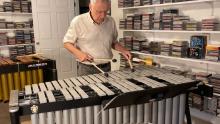
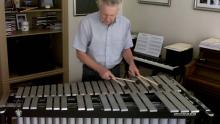
Friedman Etude #13
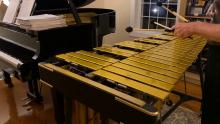
This one's for you, David! More exaggeration of dynamics! Let me know what you think.
- Read more about Friedman Etude #13
- Log in or register to post comments

This one's for you, David! More exaggeration of dynamics! Let me know what you think.
This one took me three takes because at the end on the Bb chord, I kept hitting a C in my top mallet instead of a high D. That's one of the harder chords for me to reach in this book. I also strayed a little from the Gregorian chant-like quality it's supposed to have, which is funny because I was actually really into Gregorian chants as a middle schooler. Anyway, all of the etudes I'm doing are on my YouTube channel if anyone wants to listen to them!
This is my last of the three Bud Powell solo arrangements I worked on. I really leaned into the big band vibe for this one -- there's a shout-like intro over a pedal and big hits during the melody (like that one classic jazz rhythmic cadence in the 5th/6th bar of the bridge). I also imitated walking bass during the bridge for a second, dampening each note with the pedal down to get the legato sound. There is also of course a shout chorus after my solo.
Here's a video I made with my buddy down in Chiapas, Mexico. When you enter his town there is a huge (I mean huge) sculpture of a marimba. The cool thing is I think it's made out of metal. Touche! We win!
On Marimba is Alexander Cruz a great Marimba and Vibes player!
Hanging, talking, playing!
Hi Guys today we talk about a Mc Coy Tyner lick based on quartal voicings.
Enjoy
I'm available for online private lessons!
www.giovanniperin.com
Follow me
★ facebook https: //www.facebook.com/giovanni.perin/
★ instagram: https://www.instagram.com/giovanniperin/?hl=it
I think this is probably his most famous tune, and it's great so that makes sense. This might be one of my more elaborate arrangements of a head I've done. I really tried to make the head itself have an interesting arc where every A section is different. During the bridge, I used George Shearing voicings a lot. In traditional Shearing voicings, the pianist plays a 4-part closed block chord with the right hand and doubles the melody an octave below the top voice with the left hand. This means there are often 2nds in between the bottom two voices, and that's what makes the voicing crunchy.
No matter what your stance is on guns, I think this is pretty cool!
What do you Europeans think? Very American right?
Here's the website: https://www.12gaugemicrophones.com/