Exercises

tonymiceli
5 September 2008
Yep, exercises. Yuck!
- Read more about Exercises
- Log in or register to post comments

Yep, exercises. Yuck!

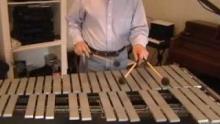
Two choruses playing the melody along with the accompaniment.
Feel free to change the rhythms of the melody and try to embellish the melody with grace notes, passing notes, fills, etc.
In terms of the accompaniment, try to get the harmony (including tensions) across either with voicings or counterpoint.
Try to get both hands to help each other out. The left hand can come up to help the right hand play the melody and the right hand can go down to fill out a voicing along with the left hand. Also, dampening is important when playing counterpoint against the melody.
This is for Barry! Here's a slow mo' of 4 in 1 with a really nice stick drop at the end. (Inside joke for long time, vibesworkshop members).
Maybe this will be of some help with the etude.
I left the sticks after the throw up there for all to examine. You see I can tell the future by how the sticks fall onto the vibes. And I see a lot of good vibe playing in the future for everyone based on that throw.
Hey guys,
I was working on something today, and decided to make it into a little video for VW... my first lesson here.
Hope u enjoy.
Steve
Here's a 4 part lesson on some concepts of chordal playing.
I was messing around with settings on my camera and trying to find some quicker ways to shoot video and I made a lesson up. Simple but you guys might dig it. Wasn't easier and had some trouple with the cam, but consider it a QDV (Quick and Dirty Video).
Just a reminder not to spend an inordinate amount of time on technique, and to think of musical ways to practice technique. After all the goal is to make music. That should be part of your practice routine! There are ways to incorporate technical practice in a musical way!