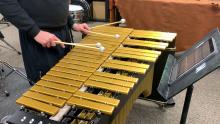

15 Week Vibe Course - Lesson 4

Due Assignments

  • Post yourself playing the melody and then chords to Blue Bossa - Unacompanied - Memorized - in time - demonstrate in class you have memorized the melody and chords
  • Play the first 4 bars of Donna Lee - MEMORIZED
  • Post Friedman #3 and 4 - Post either 3 or 4
  • Talk about the Arrival of Victor Feldman
    • Which tune is the fastest tempo on the album
    • Scott Lafaro played with another great piano player. Who?
    • What was tragic about Scott Lafaro?
    • Which tracks does Victor play on piano?

Two Five One Etude

Here's an etude of two five ones! 

I wrote in the chords but not the upper partials. You look and write in the upper partials. Play the chords and then play the solo. Is this helpful? 

The rhythm is a brazilian comping rhythm I know and have used for years. Try doing it all by yourself. It's a deceptively tricky rhythm. 

Check out the solo and the notes I'm playing. Can you learn anything from that? 

Play a Great Blues in 3 Months - Week 2 by Behn Gillece

🚨 Play a Great Blues in 3 Months – Week 2

Last week we built the foundation of our blues comping using guide tones and the Charleston rhythm. The goal was simple: clear harmony and solid time.

This week we’ll start adding a little more movement to the voicings.

Instead of keeping the upper voice mostly static, we’ll move the top note of the chord to create two different sounds for the same harmony. Even a small change in the top note can dramatically change how the voicing feels.

Harmony Without Chords Pt. 1 by Behn Gillece

🚨 Harmony Without Chords – Pt. 1: Diatonic Approaches to 3rds and 7ths

This lesson kicks off the Harmony Without Chords series by focusing on one of the most essential ideas in line construction: clearly outlining harmony using guide tones. In this first exercise, we work with diatonic approaches to the 3rd and 7th of dominant chords, avoiding chromatic notes, alterations, or upper extensions.

New Lesson Series Alert: Soloing Through the Changes - Beginner's Series - Soloing Through The Changes Pt. 1 by Behn Gillece

New Lesson Series Alert: Soloing Through the Changes 

Starting today, we’re launching an 8-part lesson series focused on helping you build clear, confident solos that outline harmony and stay rooted in the form. 

Pt. 1 – Guide Tones Over the Blues

In this first lesson, we zero in on guide tones—the essential 3rds and 7ths that define each chord’s identity. Using a 12-bar blues in F, we’ll build strong, simple melodic lines that move smoothly through the changes. No flashy licks—just solid, musical fundamentals.

Play a Great Rhythm Changes in 3 Months - Week 1 by Behn Gillece

🚨 New Series Alert – Play A Great Rhythm Changes In 3 Months

Over the past few months, we worked through Play A Great Blues In 3 Months, building a complete approach to the blues through comping, guide tones, lines, vocabulary, melodies, and chord melody.

Now it's time for the next challenge:

👉 Rhythm Changes

If the blues is one of the foundational forms in jazz, rhythm changes is the next major milestone.